
Finding Urbandale Residents Carefully
The county line decides where an Urbandale residents directory search begins. Eastern streets belong to Polk County. Western streets belong to Dallas County. Each side keeps its own deeds, cases, and certificates. The record keeper follows the land, not the mailing address. Polk makes its half easy, with an assessor search by owner or address. A map viewer is tied to tax and legal fields, and the recorder offers an online real estate index. Dallas, seated in Adel, publishes thinner tools. It often rewards a phone call or counter visit. The statewide court docket reads both counties at once. Fix the county first. Then it becomes far easier to find who lives on a street in Urbandale.
- Check the county assessor by owner name or street address, and keep the parcel number and situs address.
- Use the Iowa voter form only when the name, birth date, house number, and ZIP code are known.
- Search recorded documents by party name, then match the legal description and recording date.
- Use court, obituary, cemetery, or vital sources to separate people who share a name.
- Ask the correct custodian for a named existing record when the online route stops.
Offices Behind Urbandale Resident Records
Three Polk County offices anchor the eastern Urbandale paper trail. The Recorder preserves deeds and similar instruments. The Assessor keeps the parcel roll. The Auditor runs elections and real-estate transfers. Any western Urbandale lookup must be repeated through Dallas County, since the county line chooses the record keeper. City records, including permits, meeting files, and municipal documents, stay with Urbandale departments rather than either county.
The full address workflow sits in the Urbandale street directory. Office staff can also help by phone, mail, email, or at the counter. That backup matters when a portal is down or an older series never went online.
Searching Urbandale Property Owners
The Polk County Assessor property search is the fastest official route from a known Urbandale address to the tax-roll owner. The form accepts an address, owner name, plat, district parcel number, geoparcel number, and condition filters. One distinction deserves attention. A result can show the physical situs address separately from the tax mailing address, and the mailing side may point to a trust, company, agent, or an owner who lives elsewhere.
| Search field | Useful entry | What it narrows |
|---|---|---|
| Property Address | Full or partial street address | The parcel at a place |
| Ownership | Last and first name | Parcels on the owner roll |
| Legal | Plat or subdivision | Land when street labels changed |
| Parcel / Geoparcel | Exact identifier | One county parcel |
A parcel is a mapped unit of land, not a household. Save the search date. Compare ownership against a deed or other dated source before treating it as a resident clue.
Urbandale Deeds Connect Names
The Polk Recorder's real-estate search carries its online index from 1992 forward. Search by party name, legal description, document type, date, or book and page. A deed row names the grantor, who transfers an interest, and the grantee, who receives it. Mortgages, contracts, easements, liens, plats, trade names, and financing statements may surface too. These roles prove a documentary tie, not that a party ever occupied the address.
Older Polk records are not lost just because the web index ends. Call Imaging/Microfilm at 515-286-3175 with a legal description, book and page, or a narrow date range. Iowa Land Records opens a statewide path across all counties, and the Recorder counter, mail, email, and phone remain open channels. For western Urbandale land, route the ownership chain through Dallas County.
Keep the durable keys. Record the parcel number, legal description, and deed book and page. A portal or map can change while those identifiers remain useful.
Iowa Voter Verification in Urbandale
The Iowa voter registration search is a confirmation form, not a browseable residents directory. It demands first name, last name, ZIP code, house number, and full date of birth. A miss can stem from a recent move. It can also stem from a county boundary, a formatting difference, a protected address, or data awaiting an update. It will not run a street-wide search.
Iowa Code §§48A.34, 48A.38, and 48A.39 allow a lawful voter-list request. The request covers public fields such as name, address, registration status, party, precinct, district, and registration date. The requester must state the intended use. The requester may also select a county or jurisdiction, status group, contact profile, and certain participation fields. Social Security numbers, driver identifiers, and ballot choices stay excluded. Agency-sourced confidential data and Safe at Home addresses stay excluded too.
Those required fields explain the tool's real nature. The official state voter lookup verifies a person the searcher already knows. It does not reveal all residents at one address.
Today's Urbandale Residents Directory Sources
Every current roll has a narrow job and its own definition of a listed person. Combined, the rolls can support a careful match. None supplies a full Urbandale household roster.
| Official source | People or roles shown | Custodian | Ways to reach it |
|---|---|---|---|
| Property roll | Owners and tax-mail contacts | County assessor | Web search, phone, counter |
| Recorded-document index | Parties to deeds and other instruments | County recorder | Online, microfilm, phone, mail, counter |
| Voter records | Registered voters within statutory limits | Iowa SOS and county auditor | Verification form or lawful list request |
| Court index | Named case parties and lawyers | Iowa Judicial Branch | Free index, paid advanced search, clerk terminal |
| City staff directory | Public employees in official roles | City of Urbandale | Online department directory and phone |
Pick the roll that proves the fact at issue. A property result supports ownership. A court index supports a named case connection. Neither alone shows who sleeps at an address today, so the Urbandale resident lookup follows the full one-person verification sequence.
Urbandale Court Names Need Context
Iowa Courts Online is the first stop for district-court party searches anywhere in the state. A lookup runs on name, case number, citation, or county. The results pull back case title and party role. The results also cover case type, filed date, status, disposition, and attorneys. Treat that as an index only. Certified copies and full files live with the district court clerk. Some courthouse terminals reach deeper than the public web view.
Common names demand extra care. Match at least two facts before trusting a hit. Polk or Dallas County, a date range, and the case type all help separate people. The party's role helps too. A known address or property tie can settle it. Federal cases skip this system entirely. They run through the Southern District of Iowa and PACER. Urbandale posts no separate municipal-court name index. So an empty result should send you to the right clerk rather than to the conclusion that no case exists.
Urbandale City Files by Request
The Urbandale City Clerk holds the official city documents. Individual departments keep their own permits, reports, and working files. Meeting records sit in CivicWeb, and the city Archive Center supports keyword, date, and archive searches. CitizenServe offers a public permit search by address or parcel. A permit application needs an account.
Iowa Code Chapter 22 gives any person a right. Anyone may ask for an existing public record. Confidentiality rules and reasonable actual costs still apply. Urbandale takes requests in writing, electronically, by phone, fax, verbally, or in person. Name the record, the department, and the address or parcel. Include the date range and the nonconfidential fields you want. Estimates above $15 may require written approval first. For county records, the Polk County request portal is the counterpart.
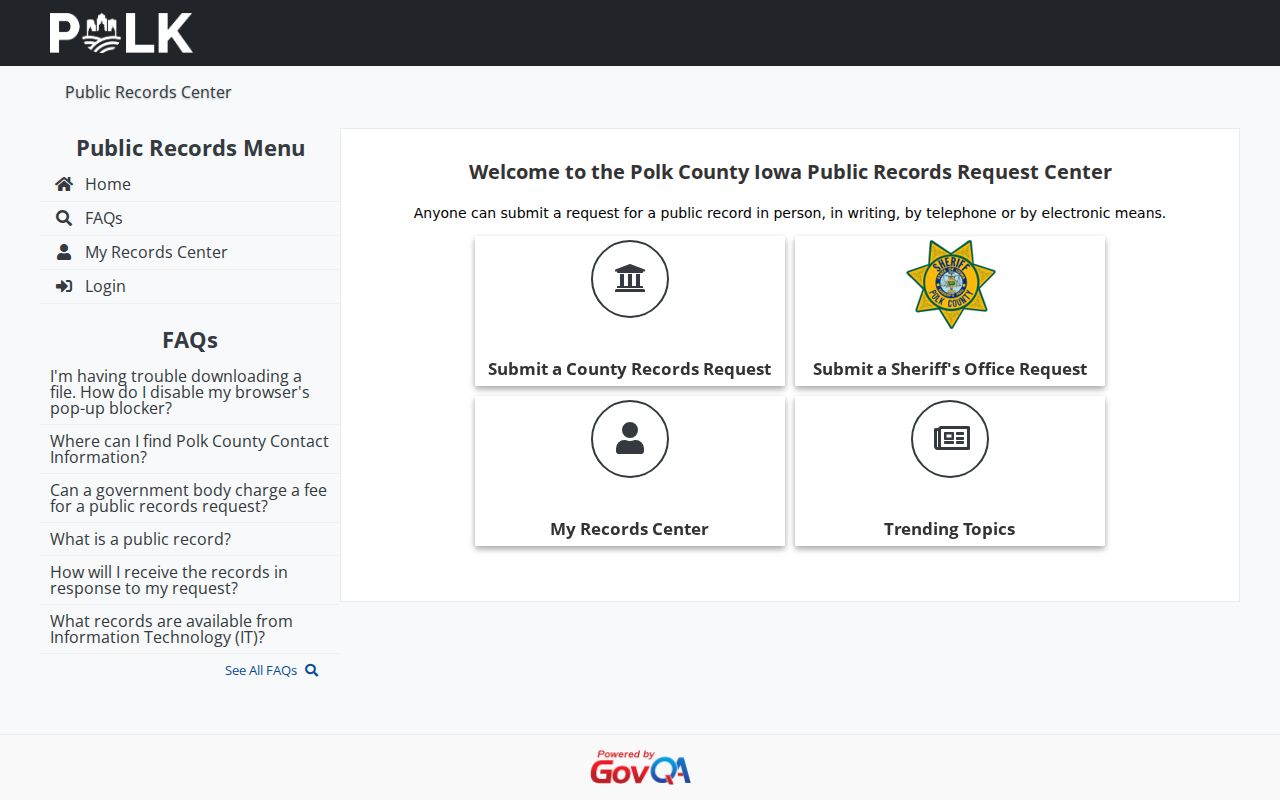
Use the portal to file and track a focused county request whenever a public search does not surface the record.
What Urbandale Index Terms Mean
Official Urbandale records carry labels that shift what a result actually means. Take each one literally before tying a name to a home.
- Roll
- A list kept for an official purpose, such as property assessment or voter administration.
- Index
- A finding aid with basic fields. It is not always the underlying document or complete file.
- Parcel
- A mapped unit of land with its own county identifier and legal description.
- Criss-cross directory
- A historical volume arranged by street address, allowing an address-to-name search.
A precise label beats a loose one. Say “tax-roll owner” rather than “resident” when the source only names the owner.
Official Urbandale Rolls Compared
Official portals and commercial people-finder services answer different questions. Public offices define each field. They publish legal limits and offer certified-copy or correction routes. Commercial services can blend public indexes with purchased address histories and guessed relationships. Their entries can be stale or merge two people with similar names.
| Route | Strength | Limit |
|---|---|---|
| Official public index | Dated fields tied to a named custodian | May show only an index or statutory public portion |
| Certified office copy | Formal copy from the record keeper | Eligibility, identification, fee, or processing rules may apply |
| Commercial category | May combine several search clues | Source dates and inferred links may be unclear |
Lawful personal use only. Use Urbandale resident records for family history, civic research, reconnecting, estate work, or fraud prevention. Never stalk, harass, or harm anyone.
Urbandale Vital and Family Trails
Vital records can distinguish people and document family transitions. But they are not an open residents directory. The Polk County Recorder issues eligible certified birth, death, and marriage copies locally. These cover stated year ranges. Iowa HHS handles statewide requests by mail, in person, online, and phone. Divorce files stay with the clerk, since HHS vital indexes and certificates follow separate rules.
Iowa Code §144.43 and Chapter 144 govern access. Historical state access opens after 75 years for birth, marriage, divorce, and annulment records. Death and fetal-death records open after 50 years. Earlier state-office records require entitlement. Certified searches and copies will cost $20 beginning July 1, 2026. For a family link, pair an eligible vital record with an obituary, probate case, cemetery record, or deed. Do not trust one name alone.
Privacy Across Urbandale Resident Rolls
Iowa's open-records law leaves plenty standing in Iowa Code §22.7 and special statutes. Juvenile, victim, medical, investigative, and motor-vehicle records can all be withheld. The Safe at Home program gives qualified survivors a substitute address with confidential mail forwarding. Protected voter addresses never belong in a public search result.
Some rosters simply do not exist. Urbandale publishes no utility-customer roster. There is no DMV address file. No complete household list is published. The city has no online municipal cemetery index and no citywide neighborhood-membership directory. Those are real boundaries. When an index is wrong, take the correction to its custodian. The Assessor handles parcel fields. The Recorder handles instrument indexing. Election officials handle registration. HHS handles vital amendments. The clerk handles court-file issues.
Two Counties Shape Urbandale Records
Urbandale's county line is the central geography rule. The older incorporated area grew west from Applegate, now 100th Street, toward the Polk County line near 142nd Street and later into Dallas County. A postal city, a ZIP code, a school district, a sewer district, a county parcel, and the incorporated boundary can each describe different ground. Never pick a custodian from the word “Urbandale” alone.
Two systems are in flux. The Polk GIS viewer is slated for replacement by the end of 2026, and the Recorder launched a new real-estate search in June 2026. Saved identifiers therefore outlast bookmarks. Keep the parcel number, legal description, recording date, deed book and page, and mailing address handy. When a parcel crosses west of the county line, repeat the whole process with Dallas County offices.
Older Urbandale Residents Directory Sources
Older directories supply the household detail that today's property rolls lack. For the metro area, the Des Moines Public Library holds city directories, telephone books, avenue guides, and criss-cross volumes. The Library of Congress lists Des Moines reverse street-address coverage for 1948 through 1972 and 1978 through 1987. Criss-cross runs appear for 1955 and 1977 through 1995, with 1983 absent from the listed set. A 1953-54 telephone directory covers Urbandale and nearby exchanges too.
The Urbandale Public Library databases layer on newspapers, census and genealogy tools. Ancestry Library Edition works inside the building. FamilySearch, HeritageQuest, and local history material round out the set. The Urbandale Historical Society keeps school pictures, yearbooks, memorabilia, and community collections at the Olmsted-Urban House. The Urbandale city directory page walks through the full shelf and entry method.
Treat a directory entry as a dated clue rather than proof. Match the name, address, spouse, occupation, and year against a census, obituary, deed, or later volume. Done carefully, that method can show who lived at an Urbandale address. It works even when the person never held title.
McDivitt Grove Cemetery opens another Urbandale-specific route. Parks and Recreation keeps the permanent interment records at 3310 86th Street, reachable at 515-278-3963. Burials extend back to the 1860s. The city cautions that early entries are incomplete, and no online name index exists. Bring a death date, a surname, and a likely burial period, then ask the custodian for the interment entry. A cemetery record can confirm a burial place. It can also separate two similar names. But pair it with an obituary, vital record, or probate file before concluding anything about family ties.
Yearbooks, school pictures, newspapers, and society collections can also reconnect a former classmate. They can identify a family from an old block. No official public alumni roll exists here. When a catalog search comes up empty, library and historical-society staff become the best fallback. They are especially useful for uncataloged photographs, local newsletters, and materials that must be used in person.