
Urbandale Directory Runs and Shelves
Urbandale does not have a verified, separate run that begins and ends neatly with the city limits. The core collection is the Des Moines-area material held by Des Moines Public Library. The books can include Urbandale names, streets, telephone exchanges, and nearby suburban labels. Coverage changes by format, so record the volume year, publisher, page, section, and exact geographic heading with each result.
| Collection | Years | Where held | Access |
|---|---|---|---|
| Digitized Des Moines city directories | 1866-1922 | Des Moines Public Library digital collection | Online; name and street/avenue sections |
| Print city directories | 1910-present | Des Moines Public Library | In-library; yearly completeness varies |
| Microfilm city directories | 1866-1935 | Des Moines Public Library | In-library microfilm and staff help |
| Reverse street-address volumes | 1948-1972 and 1978-1987 | LOC guide and library holdings to verify | Address-to-occupant research |
| Criss-cross directories | 1955; 1977-1995 except 1983 | LOC guide and library holdings | Street and block order; physical access varies |
| Telephone books | 1957-present; digitized 1953-54 and 1921-24 | DMPL and Library of Congress | Subscriber name, address, and phone |
| Urbandale local-history material | Named publications from 1967, 1970s, and 1992 | Historical Society and library archive | Photos, yearbooks, maps, clippings, newsletters |
The oldest publisher groups are Mills & Co. in 1866 and 1869, J.P. Bushnell in selected years from 1871 through 1889, and R.L. Polk in selected years from 1892 through 1922. No source confirmed that each year has the same Urbandale coverage. A regional title should therefore be cited as a Des Moines-area volume with an Urbandale occurrence, not relabeled as a city-issued roll.
Open Urbandale Directories Online
The Des Moines Public Library historic city directories guide is the first route to the 1866-1922 scans and to the print and microfilm holdings. Search a surname in the alphabetical pages, then check the street/avenue guide. Optical text search can miss initials, small type, old spelling, or a damaged page. Page-by-page reading is often more reliable once the correct surname range or street is known.
The library collection page captured for Urbandale research shows how the directory sources are split across digital, print, and microfilm access.
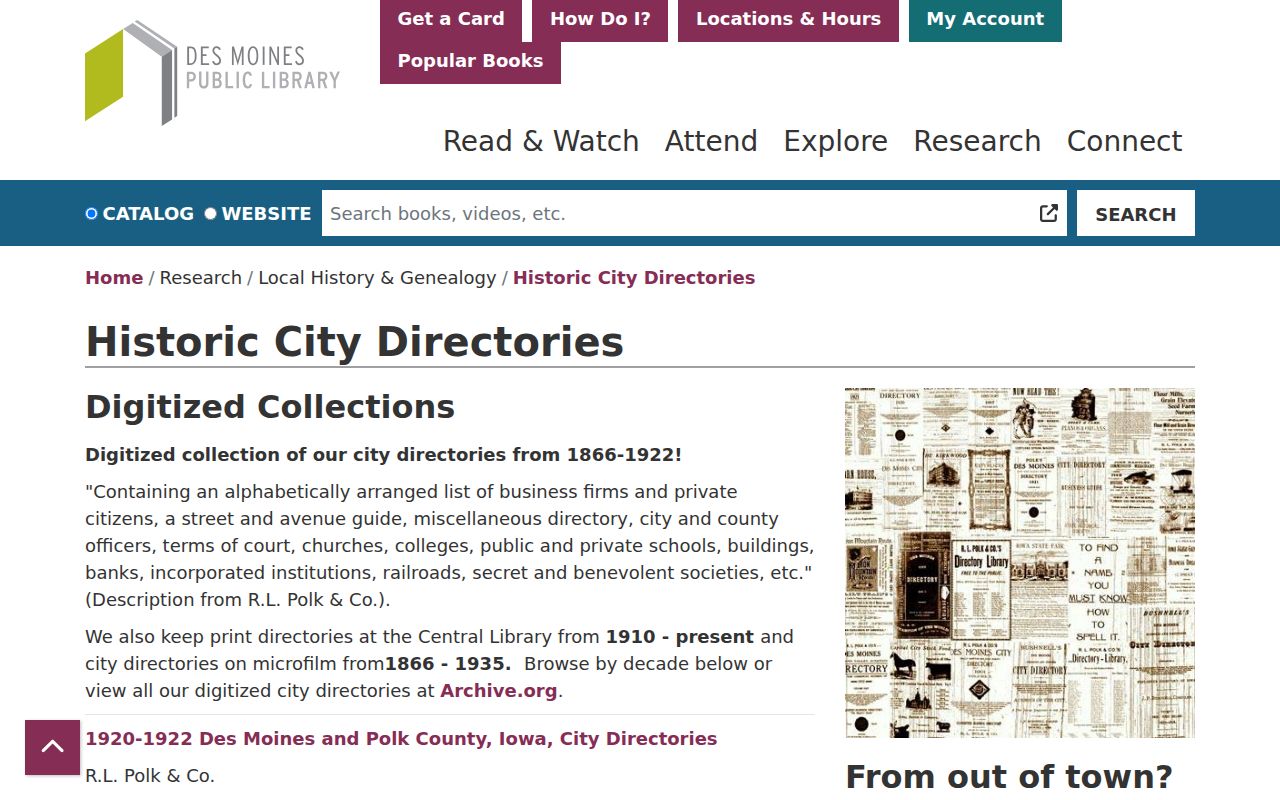
The source screen is a collection guide, not an individual resident record. Preserve the link, year, publisher, page, and the section where an entry appears.
Two Library of Congress telephone sources extend the route: a digitized 1953-54 Des Moines telephone directory that names Urbandale in its coverage notes, and 1921-24 Des Moines white and yellow pages. Telephone books list subscribers, not every adult or child in a household.
Read an Urbandale Directory Entry
No individual Urbandale entry was preserved during the source inspection, so no sample person should be invented. The verified field model comes from the collection's alphabetical and street-guide structure. Capture only what the page prints, including punctuation and abbreviations, then consult that volume's key before expanding a mark.
| Indexed name | Surname, given name or initials, and spelling exactly as printed |
|---|---|
| Second adult | Spouse or another adult in parentheses when that publisher uses the form |
| Work clue | Occupation, employer, or business, useful for separating same-name people |
| Place | House number and street, with any residence or boarding notation |
| Status mark | Owner/renter, widow, moved, deceased, or cross-reference only if the key defines it |
| Citation | Year, publisher, page, section, and regional heading |
An occupation is a historical identity clue, not a current fact. A spouse notation can lead to an obituary or probate search. An owner mark is a publisher's convention and does not replace the Recorder's title record.
- Criss-cross directory
- A volume arranged by street and number, often used to move from an address to a listed occupant.
- Householder index
- An address-oriented list of the household name selected by the publisher.
- Abbreviation key
- The volume's own legend for shortened occupations, status marks, and address terms.
- Index versus image
- An index points to a record; the page image preserves the printed context and is not a certified government copy.
Reverse Urbandale City Directory Searches
A reverse directory begins with the house number and street. The Library of Congress street-address guide identifies Des Moines volumes for 1948-1972 and 1978-1987. Its criss-cross guide identifies 1955 and 1977-1995, except 1983. This is the most direct printed route from an older Urbandale address to a listed occupant or subscriber.
The missing 1983 volume is a useful warning. One absent year cannot prove a move, vacancy, death, or publication choice. Check 1982 and 1984 when available, then use a deed, census, newspaper, or permit to test what changed. Also try nearby house numbers and alternate street spellings. Annexation and street naming can separate the old printed line from the modern parcel.
Note: A reverse entry is a dated lead about the publisher's listed person, not proof of ownership or every household member.
Urbandale Library History Sources
The Urbandale Public Library database list connects several companion sources. Advantage Archives offers free local histories, photographs, clippings, maps, and Urbandale Historical Society material. Ancestry Library Edition and FamilySearch are available in the library. HeritageQuest and historical Des Moines Register full text are available remotely to eligible cardholders. Staff and interlibrary loan can help locate a directory or yearbook missing from the local shelf; the stated ILL request fee is $3.
The Urbandale Public Library database source shows the genealogy and local-history access choices that can support a city directory result.
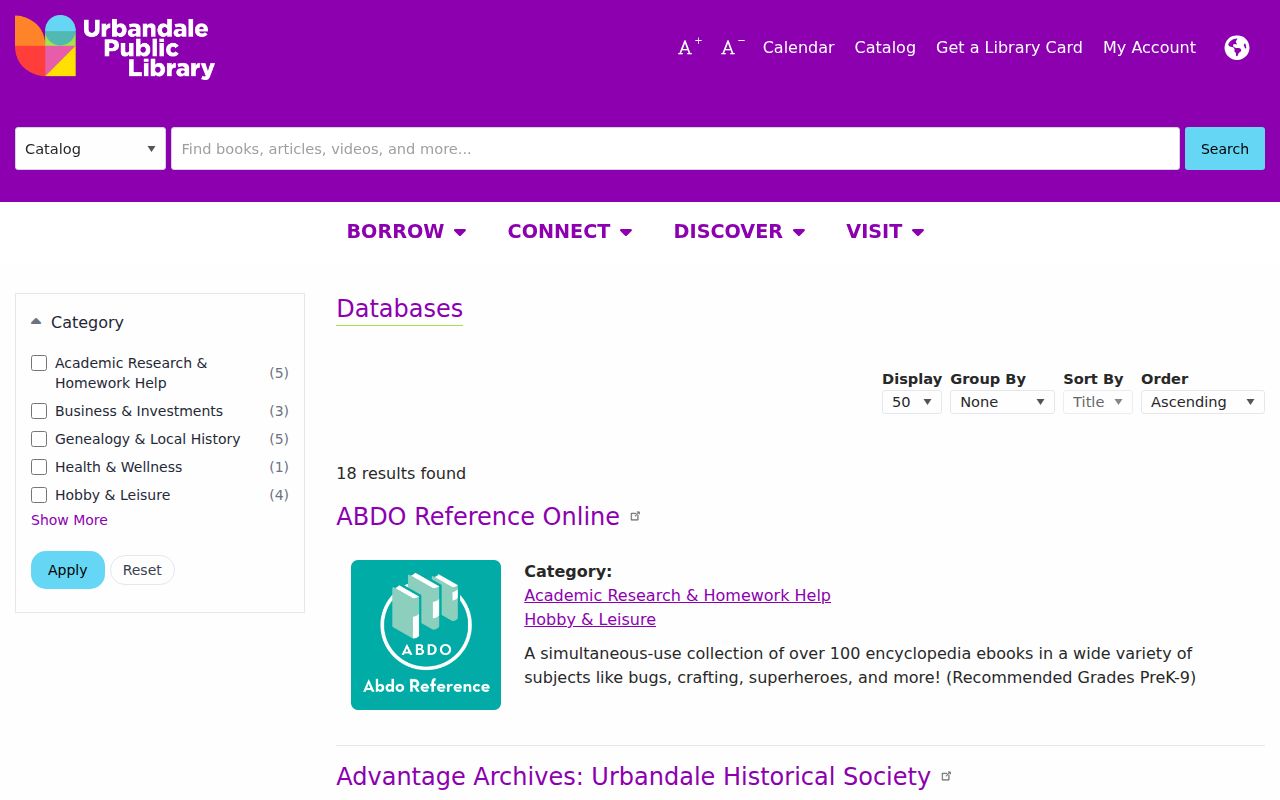
These databases fill different gaps. A scanned directory gives the printed entry, while newspapers, census material, photographs, and maps help explain the person and place.
The Urbandale Historical Society adds school class pictures, yearbooks, memorabilia, newsletters, and the Olmsted-Urban House collection. Named local works include Around Home, Urbandale from 1967, 1970s listening and learning material, and the 1992 anniversary brochure. Those items may preserve a street, school, organization, or long-time family not indexed in a regional city directory.
Urbandale Directory Eras in Context
Urbandale's record chronology is older than the city itself. Polk County archives begin in Iowa's early statehood era, while Urbandale was platted in 1907 and incorporated in 1917. A regional directory can therefore name a person near the future city before a municipal heading exists.
| Year or span | Directory and local-history meaning |
|---|---|
| 1866 and 1869 | Mills & Co. begins the digitized regional directory run |
| 1871-1889 selected years | J.P. Bushnell volumes, with gaps in the listed sequence |
| 1892-1922 selected years | R.L. Polk regional runs; digital coverage ends in 1922 |
| 1905-1951 | Streetcar construction and service era helps locate the 70th Street corridor |
| 1910-present | Print directory holdings continue at Des Moines Public Library |
| 1948-1995 selected runs | Reverse and criss-cross volumes support address-first searching |
The streetcar reached the 70th Street and Roseland turn-around and shaped the early town. Service ended in stages in 1950 and 1951. Later annexation spread Urbandale west of 70th Street. These facts help explain why a family near the old corridor may appear in a regional directory, while a later suburban address is better represented in reverse books, plats, permits, and deeds.
Trace Urbandale Families Across Years
Use city directories as annual or near-annual snapshots between the decennial census years. Keep each finding separate until its name, address, and date line up. The public federal census is available through 1950 under the 72-year release rule as of 2026. Older Urbandale residents may be filed under Des Moines Township, Saylor Township, Dallas County, or another civil division.
- Start with a known name or old address in the nearest directory year. Record spelling, initials, page, section, publisher, and regional heading.
- Move through surrounding years. Note each change of street, occupation, spouse notation, business, or cross-reference without assuming the cause.
- Switch between the alphabetical and street-order sections. Compare nearby addresses, but do not merge same-surname households.
- Pair the line with a public census year, then compare the modern parcel and legal description when the site can be identified.
- Test a disappearance with the newspaper index, obituary service, McDivitt Grove record, deed chain, probate case, or the next city's directory.
A move, death, missed suburban edition, nonsubscription, spelling error, or shelf gap can all explain an absent entry. The Urbandale street records provide the modern parcel and deed route when a historical address survives.
Close an Urbandale Directory Trail
The Des Moines Public Library newspaper index covers the Des Moines Register index from 1986-2020, Register obituaries from 1960-2020, the Des Moines Tribune from 1907-1982, and Tribune obituaries from 1960-1982. Historical Register full text reaches from 1871 to recent years through library resources. The library also offers a paid microfilm obituary search: $10 for one obituary or $20 per hour for multiple searches, up to four, with a stated ten-business-day result time.
McDivitt Grove Cemetery is a particularly local endpoint. Burials reach the 1860s, but early records are incomplete and no official online name index was located. Urbandale Parks and Recreation holds the permanent interment record and can be reached at 515-278-3963. A phone, in-person, written, or Chapter 22 request is the fallback.
For older land and family evidence, the State Historical Society lists Polk County deed indexes from 1848-1901, town-lot records from 1851-1926, mortgages, court dockets, marriages, selected births and deaths, plats, tax-sale deeds, and farm-name records. Ask by county, township, record group, approximate year, and spelling variant. That precise request is more effective than asking for a general Urbandale resident list.